
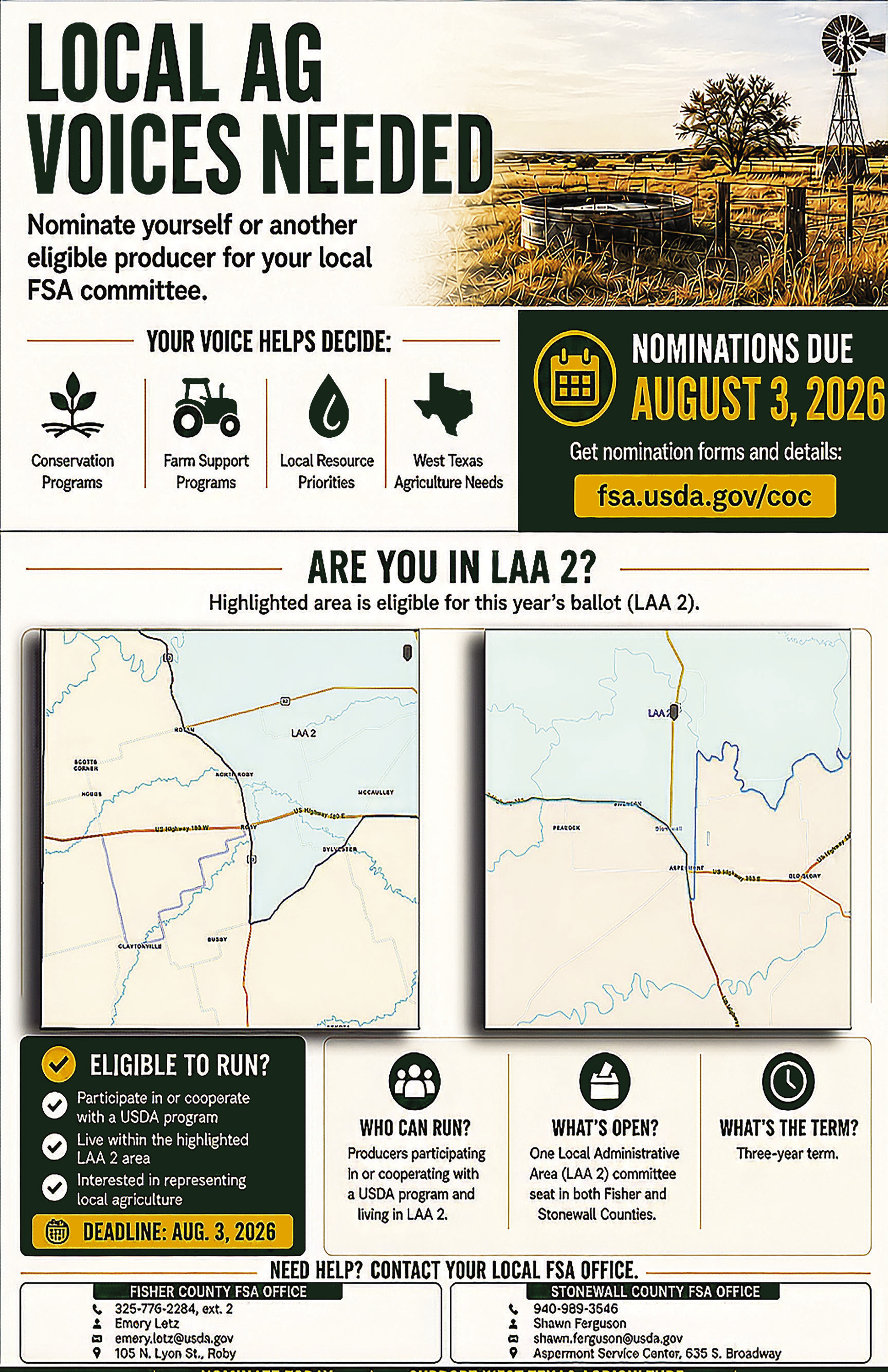
Farmers and ranchers in one area of Fisher County and one area of Stonewall County have until Aug. 3 to run for a seat on their local Farm Service Agency committee. In both counties, the zone known as Local Administrative Area 2 is on the 2026 ballot, according to the Roby and Aspermont service centers, so producers who live in those areas are the ones eligible to file this year.
USDA’s Farm Service Agency announced June 16 that it is accepting nominations for its 2026 county committee elections. Producers who want to run, or who want to nominate a neighbor, must get a signed nomination form to their local FSA office, postmarked or delivered in person, by Aug. 3. Ballots will be mailed to eligible voters in November, the agency said.
The committees are small, usually three to 11 members, and producers elect them to staggered three-year terms. Their reach is wider than their size suggests. According to the agency, committee members help decide how FSA delivers disaster recovery, conservation, commodity, and price support programs at the county level, and they have a role in county office employment decisions.
For West Texas producers, the disaster and program-eligibility work tends to matter most. When a federal program signup opens, or when an application is denied and the question becomes whether local conditions justify an exception, a committee of neighbors who farm the same ground is the body that helps sort it out. Those calls can hinge on details only someone working nearby would know, which is close to the original reason the committees exist.
Much of a committee’s work is routine: reviewing local program decisions, confirming that producers meet eligibility rules, and applying national policy tio “Producers have an opportunity to put Farmers First by ensuring local farmers and ranchers have a voice in program delivery.”
— BILL BEAM, FSA ADMINISTRATOR local conditions. The work draws little notice until a producer’s livelihood depends on it. A disaster program signup, a denied claim, a disputed acreage measurement, or an eligibility question is the kind of moment when representation on the committee stops being abstract.
The committee system reaches back to the New Deal and the Agricultural Adjustment Act of 1933, when federal farm programs began relying on local producer committees to help administer agricultural policy. The setup remains unusual. Most federal program decisions run top down through appointed staff. FSA instead routes a slice of that authority through producers their neighbors elect, a holdover from the Depression-era judgment that farmers understood local conditions better than distant administrators.
Eligibility is straightforward. A producer must take part in or cooperate with a USDA program and must live in the Local Administrative Area, or LAA, that is up for election this year. FSA defines a cooperating producer broadly: anyone who has given the agency information about a farming or ranching operation qualifies, even if that person has never applied for or received a payment. That low bar means many local producers are eligible without realizing it. Producers may nominate themselves or someone else, and qualifying farm organizations may nominate candidates as well, the agency said.
Getting on the ballot starts with one form. A producer, or anyone nominating a producer, completes and signs the FSA-669A and returns it to the local office by the deadline. Local offices can answer questions about eligibility, filing details, and whether a producer’s land falls inside LAA 2.
Local Administrative Areas divide each county into voting zones, and FSA says elections occur each year in certain LAAs. This year, that zone is LAA 2 in both Fisher and Stonewall counties. Terms are staggered so a committee never turns over all at once, which keeps some institutional memory on the panel from one year to the next.
Fisher County producers can reach the FSA office at 105 N. Lyon St. in Roby, or by phone at 325-776-2284, ext. 2. In Stonewall County, the Aspermont Service Center is at 635 S. Broadway, phone 940-989-3546. Both offices can confirm eligibility, provide or accept the nomination form, and walk a producer through registration.
FSA Administrator Bill Beam, sworn in March 2025, framed the nominations in the language the current administration has used across its farm policy. Producers have a chance to “put Farmers First by ensuring local farmers and ranchers have a voice in program delivery,” Beam said in the announcement.
The timing gives the 2026 election added weight. This has been an unusually busy year at FSA. Under the Working Families Tax Cuts Act, also known as the One Big Beautiful Bill Act, landowners have from June 1 through Aug. 31 to weigh a one-time chance to add base acres to the Agriculture Risk Coverage and Price Loss Coverage programs, and the same law raised the annual commodity payment limit from $125,000 to $155,000 and changed how partnerships, limited liability companies, and similar entities are treated. Those changes move through local FSA offices, and the committees in place will help oversee how they land at the county level.
Nationwide, more than 7,700 producers serve on FSA county committees, according to the agency. The system has outlasted repeated reorganizations of the federal farm bureaucracy, including the 1994 consolidation that produced the modern Farm Service Agency.
Candidates must sign form FSA-669A, available at the local office and at fsa.usda. gov/coc. Eligible producers who do not receive a ballot in November can request one from their office. Producers who are not sure whether they live or farm in LAA 2 should contact the Roby or Aspermont service cen-