
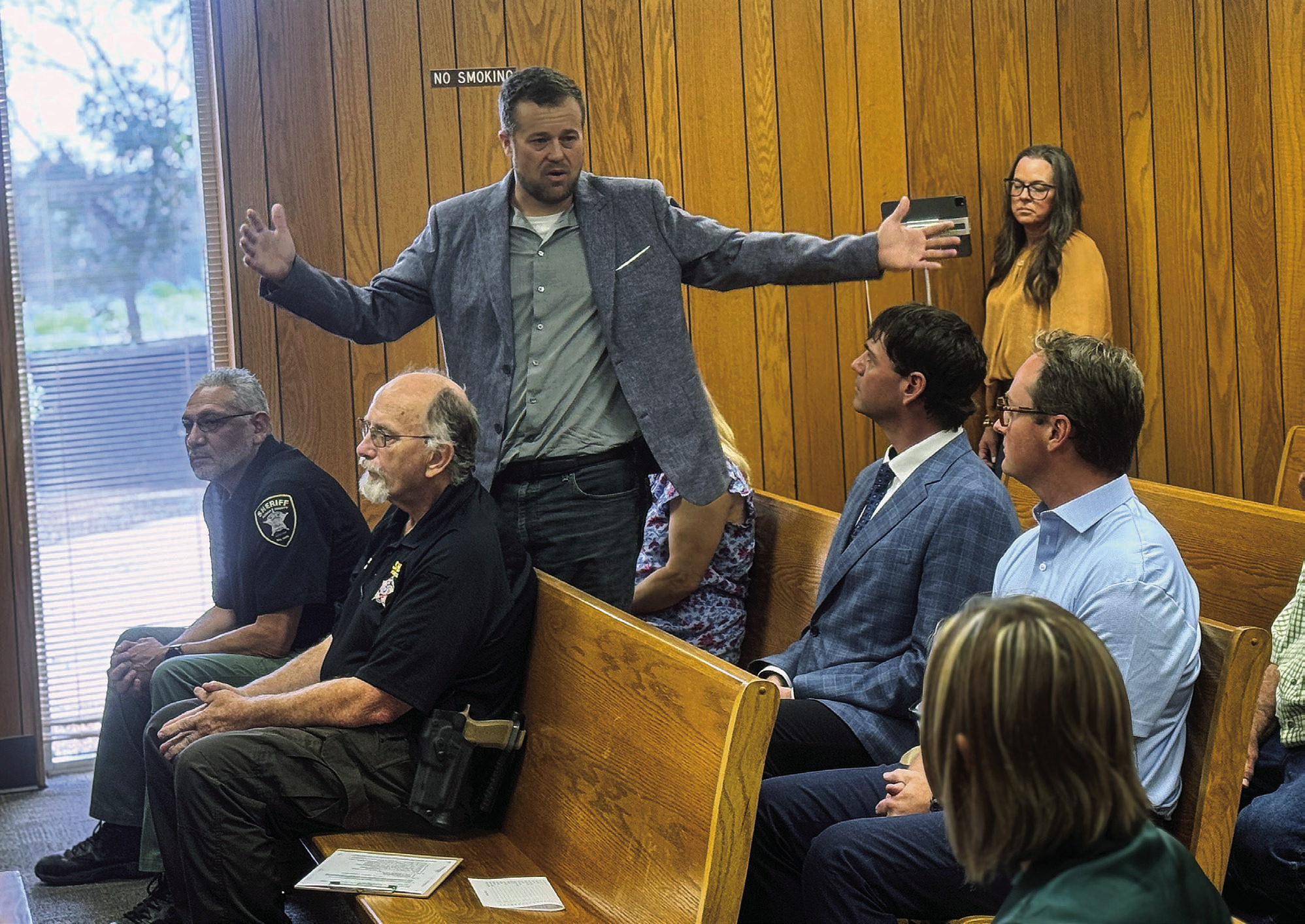
The Fisher County Commissioners Court unanimously approved a water line easement during its June meeting, allowing Bair Energy LLC to move forward with early water infrastructure for a proposed energy and water project near Sylvester that company officials say has been in development for nearly four years.
The easement authorizes a proposed pipeline route crossing U.S. Highway 57 before following County Roads 110 and 115 to connect privately owned groundwater resources acquired from participating landowners. Company representatives described the pipeline as the first component of a broader project that would support hydrogen production, electric generation and future industrial development.
Bair Energy Vice President of Development Kyle Medders reminded the court how the company has been working with Fisher County for several years while developing what began as a hydrogen project. He added how they have acquired groundwater rights from landowners primarily along County Roads 110 and 115 and intends to connect existing agricultural wells for supplying water for future energy production.
“We’re going to establish a collector system to put in some energy generation for the state’s energy security,” said Medders.
According to Medders, the project includes hydrogen production, gas turbine generation, fuel cells and steam-cycle electricity production. He said the company is pursuing multiple electric generation projects through ERCOT’s interconnection process while developing the supporting water infrastructure.
Although the easement involves only a water pipeline, company officials described the project as much broader than a single hydrogen facility.
According to a proposal submitted to the county, the pipeline is intended to serve the proposed Clear Fork Agriculture and Energy and Water Complex, which the company says could eventually support agriculture, electric generation, industrial development and future commercial growth. The proposal also discusses the potential for treated groundwater to serve future community needs, subject to regulatory approval.
Officials devoted much of their discussion to groundwater production and longterm water management. Commissioner Micah Evans questioned whether the company planned to drill deeper wells than those currently used by area landowners.
“We haven’t drilled anything yet,” said Medders. “We’re using existing wells right now that are already provided.”
Medders added that the company plans to connect those existing wells into a collection system rather than concentrate production from only a few locations. He estimated peak demand at approximately 235 to 300 gallons per minute during power plant operation.
He also said many of the wells contain elevated mineral concentrations, including magnesium, iron and total dissolved solids, making the water less desirable for drinking without treatment. Bair Energy plans to install a treatment facility before using the water for industrial purposes and said any future connection to the Sylvester-McCaulley water system would require approval from the Texas Commission on Environmental Quality.
Commissioner Stuart Posey asked how participating landowners would benefit from the system. Medders explained that the company plans to install taps near some stock tanks so water could be supplied during drought conditions or other emergencies.
“We’re not just going to take it,” said Medders.
Following the meeting, Bair Energy CEO Nicholas Ian Bair said water management has been central to the company’s philosophy since its founding in 2012. The company’s founders began in geothermal energy before expanding into broader energy infrastructure after experiencing water disputes in Oregon’s Klamath Basin, where his family’s agricultural operation was affected by irrigation restrictions.
“We came out of ag,” said Bair. “We came out of a very devastated area from water wars. And we said there’s a better way to write a water-use plan that meets everybody’s expectations. It’s transparent.”
He said the company intends to develop a closed-loop water management system that balances agricultural, industrial and community needs while supporting long-term energy production. Bair also said the company is focused primarily on energy generation rather than recruiting data centers, though he acknowledged increasing interest from technology companies seeking power.
“We are not a data center company,” said Bair. “Data centers came in because we were producing and providing land to onshore American manufacturing and make energy for the United States.”
The proposed Clear Fork hydrogen production project is one of several large-scale energy and infrastructure developments underway in Fisher and neighboring Stonewall counties as utilities, energy developers and technology companies pursue new generation capacity and industrial investment across West Texas.
For Bair Energy, however, commissioners’ approval represents only an early step. Additional engineering, regulatory approvals and infrastructure development will be required before construction of the broader project can move forward. The approved easement marks the company’s first publicly authorized county infrastructure related to the proposed Clear Fork development.