
County payroll records show Chief Deputy Amanda Reyes and Patrol Sgt. Roberto Castilleja received 96.7% of Sheriff’s Office overtime over 13 months, while the records reviewed did not independently verify every underlying hour.
The first article in this series examined the budget record: how Sheriff’s Office overtime closed fiscal year 2025 far above the adopted overtime budget, and how the county later reconciled those lines through amendments. This article examines the hours behind the payments: what employees submitted, what the Sheriff approved, what payroll processed, and what the reviewed records do not independently verify.
Nearly all of the overtime Fisher County paid its Sheriff’s Office over the past 13 months went to two sheriff department employees.
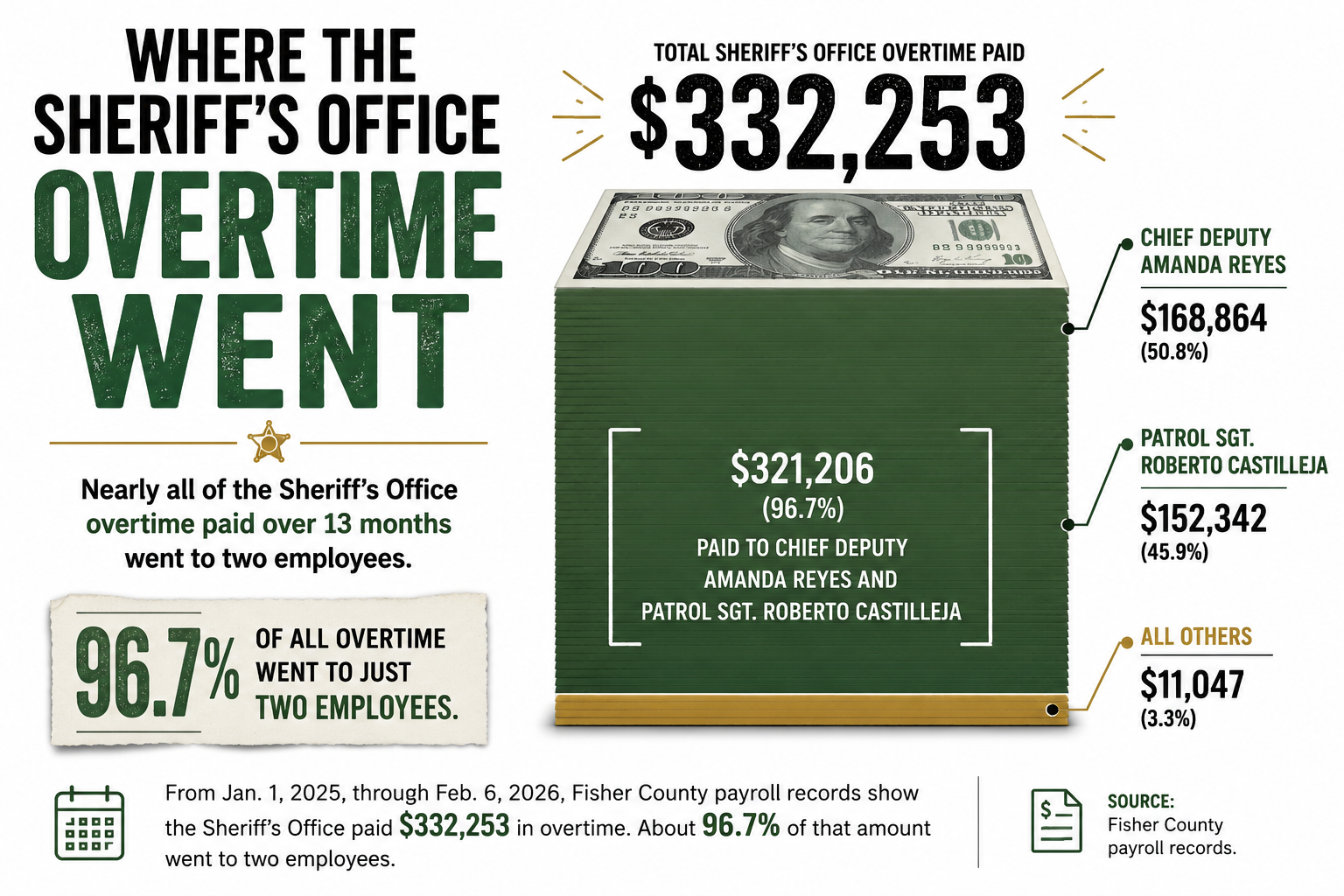
From Jan. 1, 2025, through Feb. 6, 2026, county payroll records show the Sheriff’s Office paid $332,253 in overtime. Of that, $321,206 — about 96.7% — went to Chief Deputy Amanda Reyes and Patrol Sgt. Roberto Castilleja.
Reyes received $168,864. Castilleja received $152,342.
Official payroll records show the county paid the overtime hours as submitted.
HIGH COMPENSATION HOURS
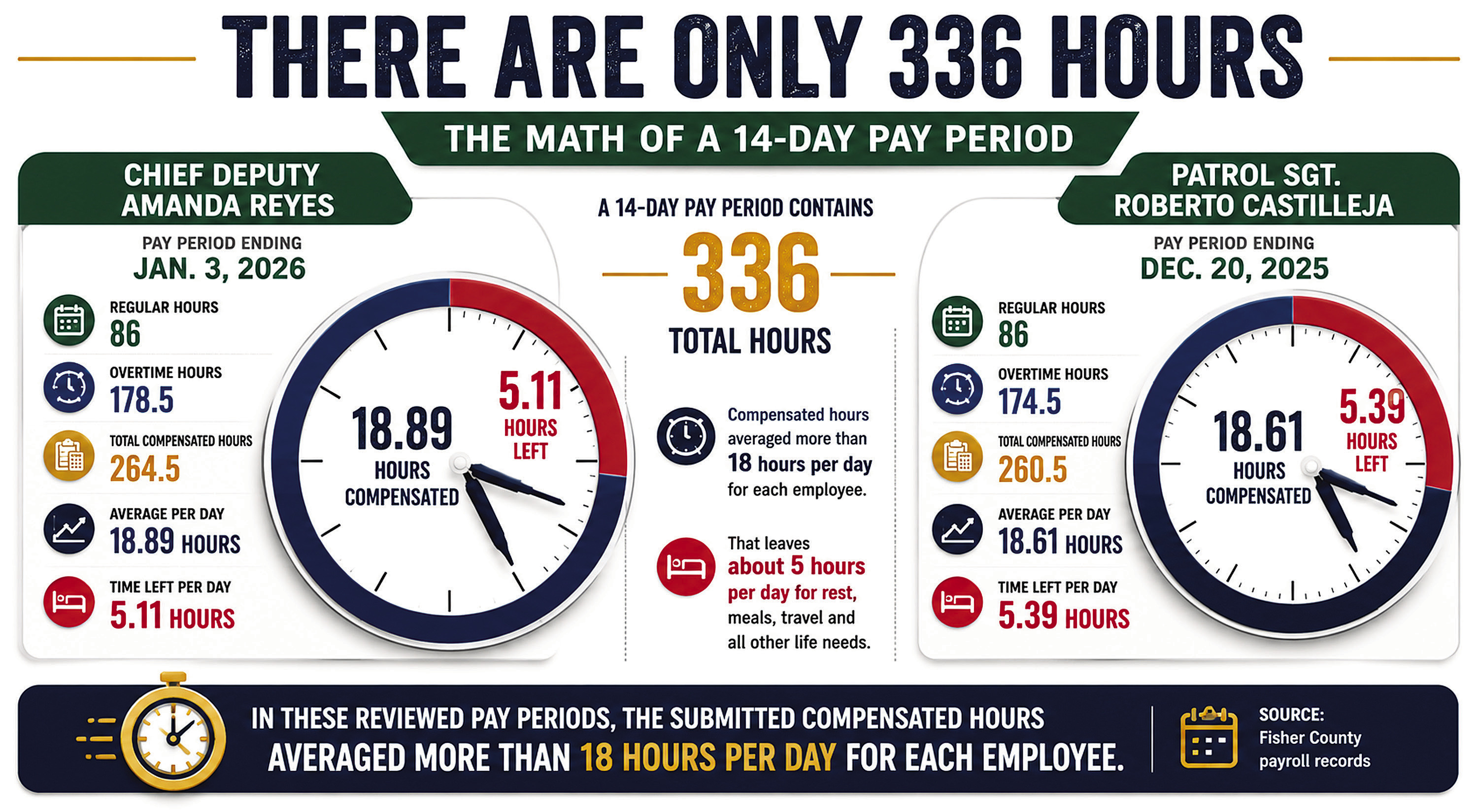
There are 336 hours in a 14-day pay period. Sleep, meals, travel and every other part of a life have to fit somewhere inside them.
For the pay period ending Jan. 3, 2026, payroll records show Chief Deputy Reyes was paid for 178.5 overtime hours and 86 regular hours, for 264.5 compensated hours over 14 days.
That averages 18.89 submitted hours per day, leaving 71.5 hours in the period, or 5.11 hours per day, outside the submitted total for rest and personal needs.
Patrol Sgt. Castilleja’s records show a similar pattern. For the period ending Dec. 20, 2025, Patrol Sgt. Castilleja was paid for 174.5 overtime hours and 86 regular hours, for 260.5 compensated hours over 14 days.
That averages 18.61 compensated hours per day, leaving just 5.39 hours for rest.
A separate review, built from the timesheets rather than the payroll register, shows the long shifts were not confined to those two pay periods. The DMC counted only entries it could visually confirm and excluded holiday pay.
Within that set, Reyes recorded 75 dates with daily totals of 17 or more hours, including 30 dates with 19 or more and 13 dates with 20 hours or more. Castilleja recorded 27 such dates at 17 or more hours, including four dates with 19 or more.
By Feb. 6, 2026, overtime made up roughly 70% of Reyes’s total compensation and about 67% of Castilleja’s.
Each had earned more in overtime than in regular salary.
The county timesheet form carries a printed warning, above the signature line, that knowingly false entry or alteration is a violation of Texas Penal Code Section 37.10.
“TAKING CARE OF BUSINESS”
The DMC contacted Sheriff Pat Dickson for clarification about what steps he took before signing timecards showing daily totals of 17 or more hours. The sheriff defended those hours.
“They were taking care of business,” said Dickson. “If that’s what was claimed, that’s what happened, because we have too many calls where a deputy may actually think they’re done and then another call comes in, and they’re right back on it. They never actually get to go off shift.”
When asked whether 19-hour days for 14 days straight raised safety concerns, Dickson said it did.
“It does certainly raise a concern,” said Dickson, “but at the same time, it’s kind of the hand we were dealt.”
The DMC also contacted the Texas Commission on Law Enforcement (TCOLE), the agency that regulates peace officer standards and licensing. We asked whether Texas has any statewide rule or best practice guidance concerning officer fatigue, extreme scheduling, and supervisory review of unusually long shifts.
TCOLE Director of Government and External Relations Gretchen Grigsby clarified that the agency does not set maximum shift lengths or minimum off-duty rest periods for county peace officers, nor does it issue training in that area. She said staffing and scheduling decisions are left to local departments.
While this does not resolve the fatigue question, it does clarify where accountability rests: at the local level, inside the department and county offices that approved the hours.
NO POLICY MANUAL
The Sheriff’s Office was unable to produce a department policy manual in response to the DMC’s March 2026 Texas Public Information Act (TPIA) request. Sheriff Dickson wrote that the office did not have a handbook or policy manual at that time. He attached a November 2025 memo addressing scheduling, dispatcher overtime and supervisor approval of schedule changes.
Through a confidential source, the DMC obtained an older copy of the FCSO Policy Handbook used by previous administrations prior to Dickson’s January 2025 appointment. Former Fisher County Sheriff Randy Ford — who served the county from 2021 – 2023 — confirmed the authenticity of the document.
Within that manual, Section 3-11: Authorized Duty Hours states: “It is the desire of the Administration that employee work time is scheduled and regulated to maximize the efficient use of personnel. Compliance with all County policies regarding compensation is further required.”
THE COUNTY’S RULES
The county’s employee handbook requires employees to get authorization from a supervisor or elected official before working overtime, except in emergencies.
The DMC reviewed the overtime notes attached to the sheriff deputies’ long work periods. They did not describe a declared emergency or a continuous crisis.
They listed individual calls and activities — among them a burglary alarm in Rotan, a domestic call on Highway 70, a warrant arrest, an assault arrest in Rotan, loose cattle on 180, a deer strike, and the Rotan Christmas Parade.
The reviewed records included timecards Sheriff Dickson approved with overtime-note pages that were blank or contained no specific call or activity explanation. When asked how the overtime was justified without completed authorization forms, Dickson said: “Because I knew that’s what they did.” The DMC also asked why, within those long pay periods, the forms could not be completed before timesheets were submitted.
“It’s already 2 a.m. and then you end up getting called right back out, and then by the time two weeks roll by, you don’t remember every little detail,” said Dickson. “This is not something that we're gonna necessarily have every ‘I’ dotted and ‘T’ crossed.”
While the DMC did not locate written overtime pre-authorization forms, it does not establish that no such records exist. It means the payroll, timesheet, policy and interview records reviewed for this article did not include separate written overtime pre-authorization forms.
In the records obtained, however, the overtime moved through payroll primarily through employee-submitted timesheets, which the sheriff approved.
A QUESTION OF STAFFING
Dickson and County Auditor Becky Mauldin both pointed to a chronic staffing shortage — for most of the year, as the office ran on two deputies. However, the records complicate that explanation.
Payroll records first list Shane Keisling joining the roster on Aug. 19, 2025. Nevertheless, overtime did not fall. In fact, records show a slight increase.
In contrast to the deputy hours, the earlier mentioned November memo — which Dickson provided in lieu of a department policy — capped dispatchers at a 40-hour week, and civilian dispatcher overtime declined afterward. Sworn law-enforcement overtime did not.
From mid-October 2025 through early February 2026, sworn-officer overtime held between $12,873 and $15,177 each pay period. The records do not reveal why sworn overtime remained in that range after additional staff appeared on the payroll.
“There's many different reasons for this. Everything from vehicle breakdowns to where you had to have someone out to do transport, because usually I would do transport. And now the deputy has to do it because we were short vehicles,” explained Dickson. “Why there's this perception that there's something nefarious going on here, I have no idea.”
Whatever drove the hours, the decision to approve and pay them rested locally — with the Sheriff’s Office and the county offices that processed the payroll.
THE MANUAL SYSTEM Countywide, employees enter their own hours by hand using Excel timesheets, which the treasurer’s office then reviews. Fisher County does not use an electronic clock-in system.
“I wish we had a timekeeping system like that,” said Fisher County Treasurer Jeanna Parks, adding that an electronic time-keeping systems has been a topic commissioners have discussed in the past but were not inclined to implement.
“We tried really hard to get them to agree to allowing us to do that because that would make my life so much simpler. But it got shut down.”
Additionally, within the timesheets were several hand-written alterations, including red ink corrections, which Parks confirmed were made after the timesheets were submitted to her office.
“It’s me making corrections to what I see as an error,” said Parks, adding that she watches law-enforcement entries closely because of the 86-hour work period.
The records show corrections to hour totals, leave categories, and pay amounts.
The question the records raised for the DMC was not whether any individual correction was wrong, it was whether the county had enough independent documentation to verify the largest overtime claims before those hours moved through payroll.
Parks also said she did not receive separate overtime authorization forms, and that once an employee and a supervisor signed and submitted a timesheet, that document was what authorized payment from the budget. Policing overtime, she said, was not the treasurer’s role.
WHERE OVERSIGHT RESTS
If the treasurer’s office did not independently validate the underlying need for overtime, the county’s additional financial check-and-balance was the county auditor.
A Texas attorney general opinion recognizes auditor discretion to refuse to co-sign salary warrants in some circumstances, although it does not directly address overtime audits. When asked whether the extreme entries were ever treated as grounds to question a payroll warrant, Mauldin noted that limitation.
“First of all, that’s an opinion,” said Mauldin. A payment would be questioned only if it “was something that either was brought to my attention or that was looked into for a reason.”
The DMC asked whether 19-hour days submitted for 14 days straight raised any red flags.
Mauldin pointed to staffing shortages: “We’ve had overtime at the sheriff’s department for all the years that they’ve worked overtime, not just this last year. There were only two deputies, and we did not have a full staff.”
HOW 2025 COMPARED
Historical county financial-condition reports show Sheriff Department overtime was not exactly novel, as deputy overtime lines reported activity in earlier years.
However, FY2025 stood apart from the department’s history.
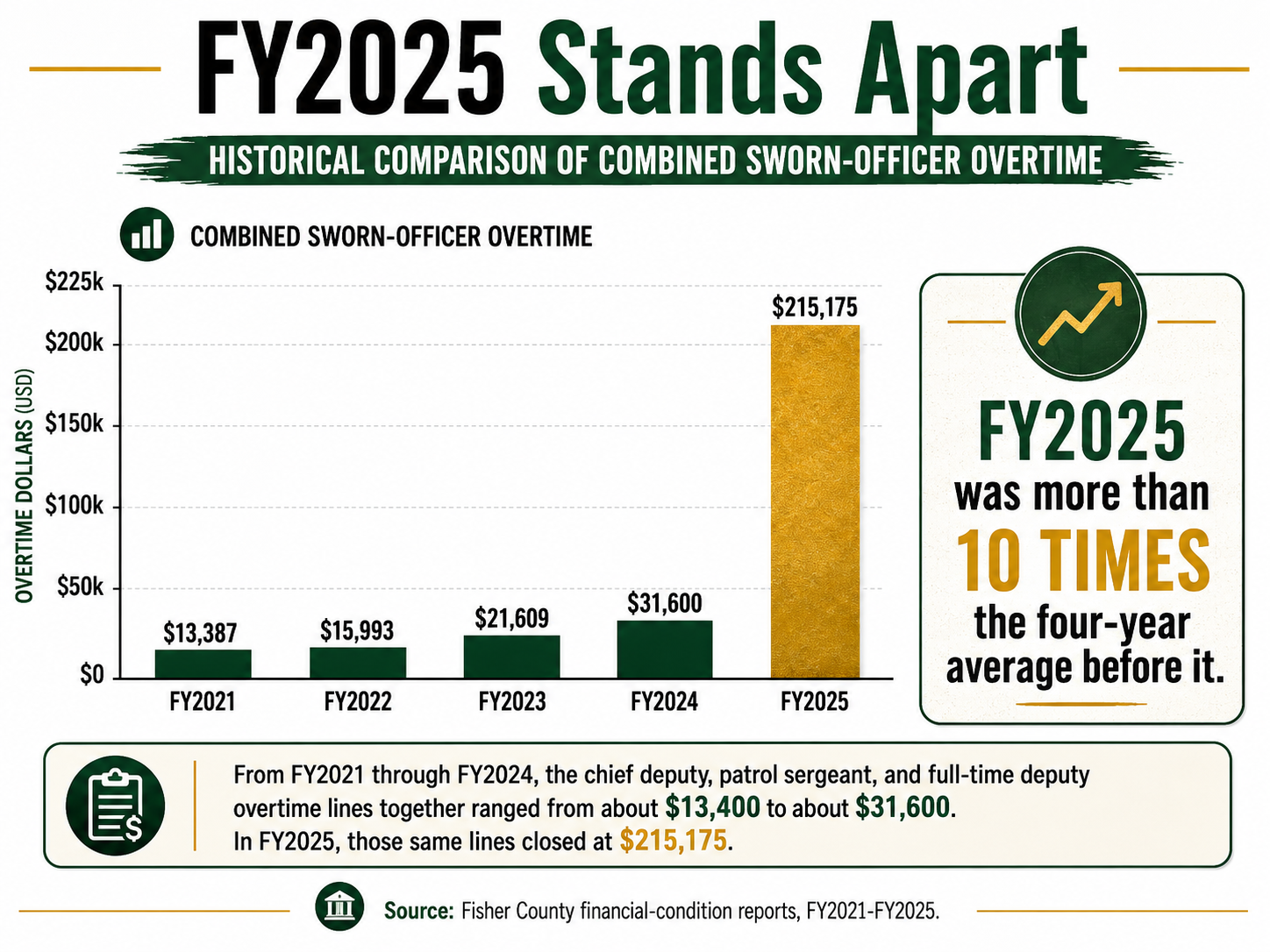
From FY2021 through FY2024, the chief deputy, patrol sergeant and full-time deputy overtime lines together ranged from about $13,400 to about $31,600 a year.
In FY2025, those same three lines closed at $215,174 — more than ten times the four-year average before it.
Most of the FY2025 increase came from two budget lines.
The chief deputy overtime line closed at $110,851 and the patrol sergeant’s at $80,028. The full-time deputy line, at $24,296, did not show the same jump.
Figures are the actual year-end overtime expense recorded on the Sheriff’s Office’s three sworn-officer overtime lines in county financial- condition reports — not total department overtime, which also includes dispatch and other lines. Rounded to the nearest dollar. Source: Fisher County financial-condition reports, FY2021–FY2025.
WHAT THE RECORDS DON’T SHOW The records reviewed do not establish that any specific hour was not worked. They only confirm the county paid unusually high compensated- hour totals based primarily on employee- submitted timesheets approved within the Sheriff’s Office, under a manual system with no electronic clock-in.
In the records reviewed, payment appears to have followed employee-submitted timesheets approved within the Sheriff’s Office. Whether the hours behind those payments can be independently verified is a question those records leave open.
This is not the only question that payroll stream raises. The same records point to additional employee-compensation questions — ones the Chronicle will take up separately as this series continues.