
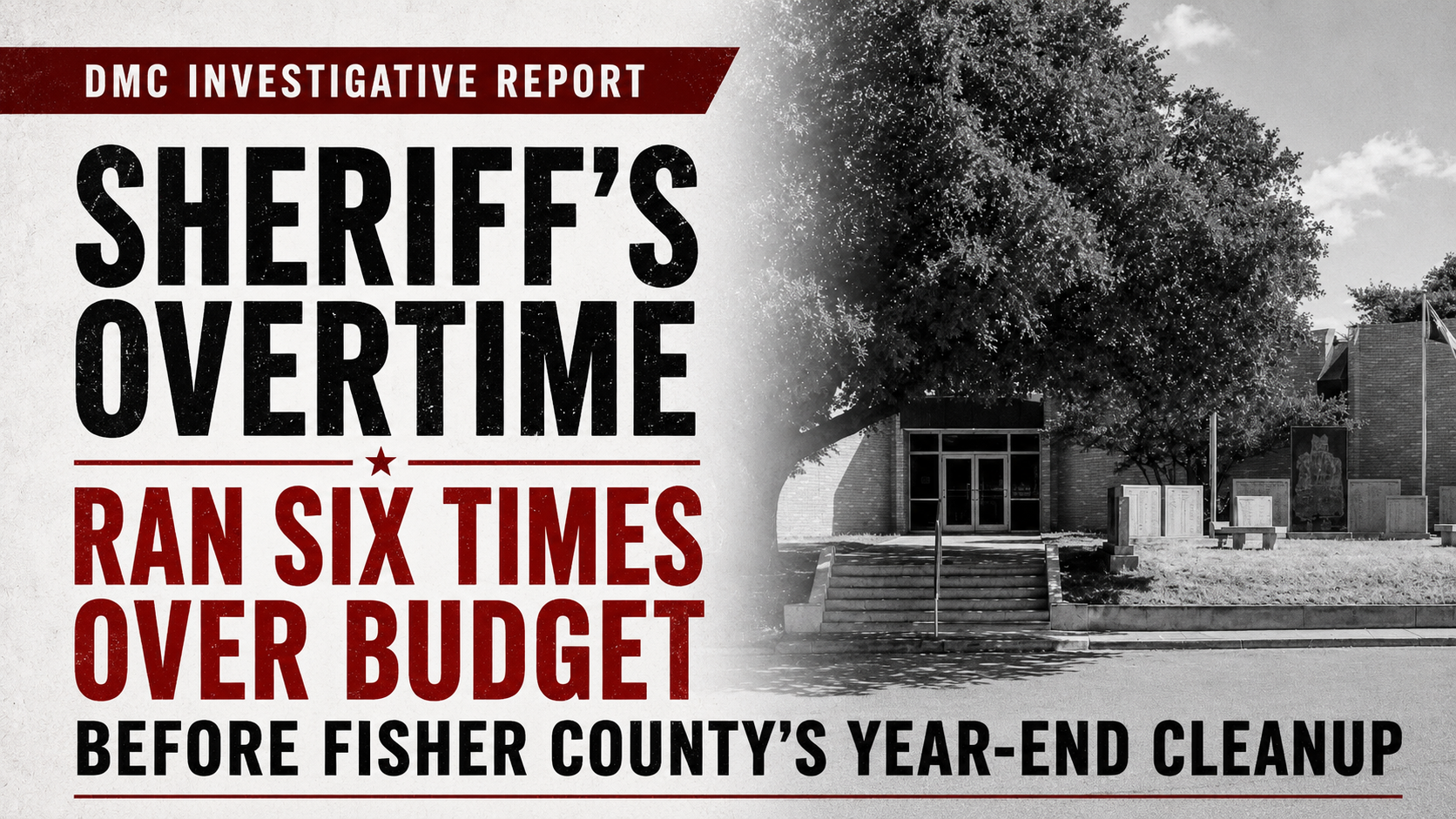
County records show sworn-officer overtime reached $215,175 against a $35,689 adopted budget in fiscal 2025, while substantial budget changes came through year-end amendments after the spending occurred.
 Fisher County's year-end financial ledger shows the sheriff's sworn overtime lines closed fiscal year 2025 at $215,175 against an adopted overtime budget of $35,689 — more than six times the original budget. Officials offered a simple explanation: too few deputies, too many calls, and too much area to cover in a county of roughly 900 square miles.
The Double Mountain Chronicle tested that explanation against the county's payroll records, timesheet ledgers, adopted budget, and commissioners court actions. The records pointed to a larger problem than staffing shortages alone.
This first article examines what the budget records themselves show: overtime that closed the year far beyond the adopted budget, an in-year amendment that touched those lines only slightly, and a set of year-end amendments that reconciled the department's books after the money had already been spent.
Later articles in this series examine the individual timesheet claims and the county's oversight of them.
INITIAL INVESTIGATION
The DMC did not begin this inquiry expecting it to expand into a broader investigation involving multiple county offices. The starting question was much simpler: were the overtime hours justified?
We concluded the most direct way to test that question was to compare deputies' timesheets with the sheriff's department's GPS/AVL vehicle movement records. We requested both. The timesheets were produced. The GPS/AVL data was not.
The dispute over those withheld vehicle records led DMC Editor Jeff Hurt to file a petition for writ of mandamus in February. At an April 29 hearing, 32nd Judicial District Judge Glen Harrison ordered the sheriff's office to release the GPS/AVL records.
The parties continue to dispute whether the county's later production complied with that order.
While the GPS request remained unresolved, the DMC turned to other county records, which is how the reporting widened from a narrow overtime question into a broader review of payroll, patrol coverage, and county oversight.
The first finding narrowed the issue, as the county's payroll system does not appear to have broken down mechanically. Cross-checking physical timesheets against payroll reports and employee earnings statements showed the records were internally consistent: the accounting software converted submitted hours into pay accurately, and the county's overtime formulas were applied correctly.
The math worked. That shifted the inquiry away from clerical or accounting errors and toward the records themselves — what was being submitted, and how.
The Fisher County Employee Handbook (sections B-8 and B-9) requires supervisor or elected-official authorization before an employee works overtime, except in emergencies. The records the DMC reviewed contained no written pre-authorizations for the overtime described below.
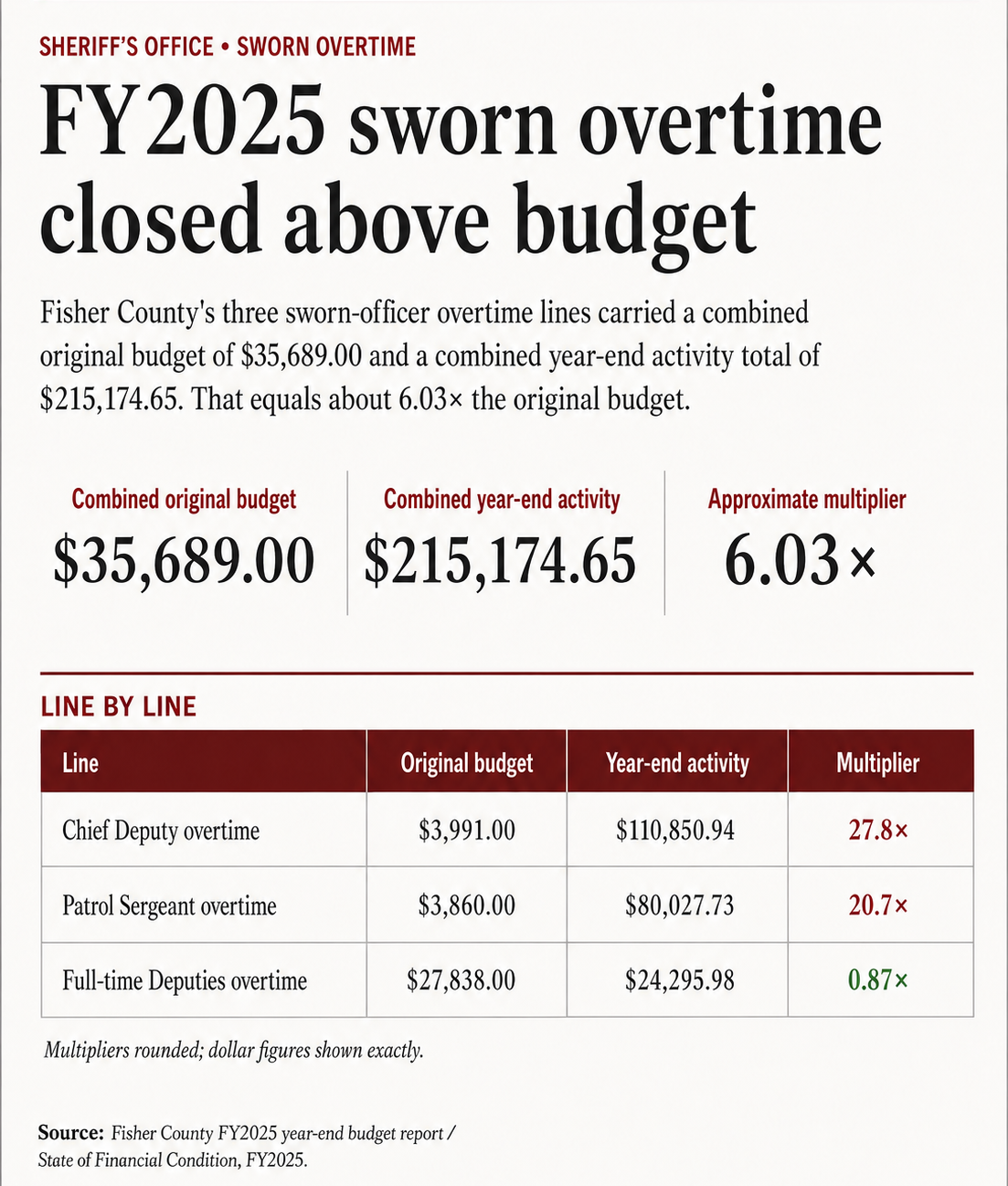
According to the county's Year-End State of Financial Condition report — its Budget Analysis Usage Report — FY2025 sworn law-enforcement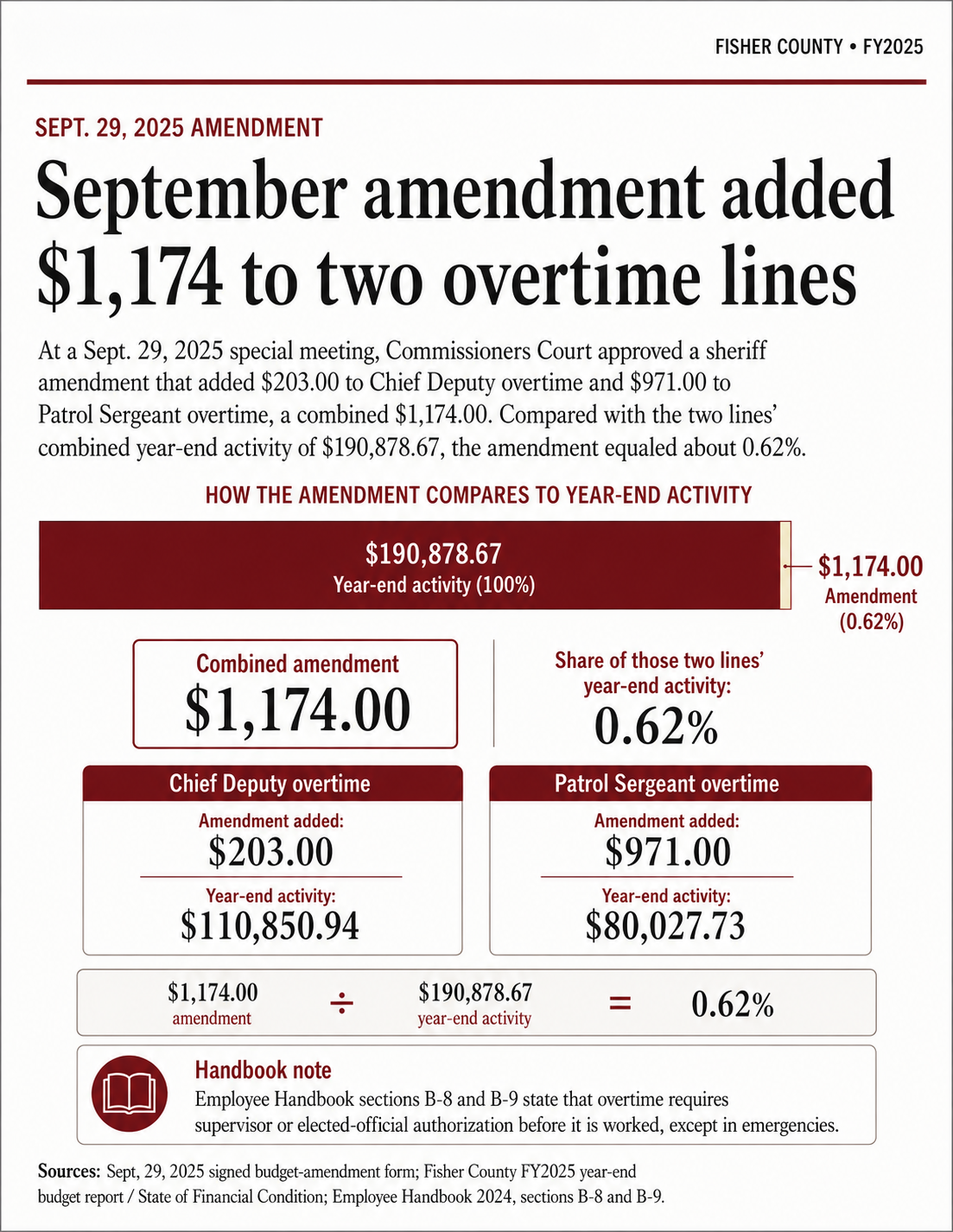 overtime closed as follows. The Chief Deputy overtime line closed at approximately $110,850 against an adopted budget of $3,991. The Patrol Sergeant overtime line closed at approximately $80,027 against $3,860. The full-time deputy overtime line closed at approximately $24,295 against $27,838.
Together, the three sworn officer overtime lines closed at $215,175 against a combined adopted budget of $35,689 — more than six times the originally adopted budget.
A separate Law Enforcement Center dispatcher overtime line closed at $67,928 against a budgeted line of zero dollars. Because that line sits in a separate budget section, this article does not include it in the sheriff sworn-overtime total.
A review of 18 commissioners court minute packets from October 15, 2024 through February 9, 2026 identified only one recorded amendment before fiscal year-end that directly addressed the sheriff's overtime lines. On September 29, 2025, the county held a special-called meeting, where the court approved a sheriff's office budget amendment consisting of ten line-item adjustments.
The explanation on the signed form focused partly on FICA, which stated: "OVERTIME CAUSED FICA TO GO OVER, & SEVERAL MINOR WRECKS WITH ANIMALS. COMMUNICATIONS NOT ENOUGH WAS BUDGETED."
The amendment placed small amounts directly into two overtime salary lines: $203 into Chief Deputy overtime and $971 into Patrol Sergeant overtime, for a combined $1,174.
By the close of the fiscal year, those same two overtime lines had reached a combined total of approximately $190,878 — against an originally adopted combined budget of $7,851. The September 29 amendment increased those two overtime budgets by only $1,174, less than one percent of what the two lines ultimately spent.
A second amendment affecting those lines was approved after fiscal year-end, at the October 14 meeting, as part of the county's FY2025 closeout.
A YEAR-END CLEANUP — AND A QUESTION OF TIMING
 The county did address the overtime overruns, but not as the spending accumulated. It did so at the close of the year, at a meeting held after fiscal year-end that affected the FY2025 closeout — and the specific amounts were not stated aloud during the meeting.
At the October 14 session, the amounts of the end-of-year amendments were not read into the record, and the meeting video does not capture them. A taxpayer watching the recorded proceeding, or reading the minutes alone, would have no way of knowing what those amendments totaled or which lines they touched.
That information only appears in signed amendment forms contained deep within the county's 222-page meeting packet.
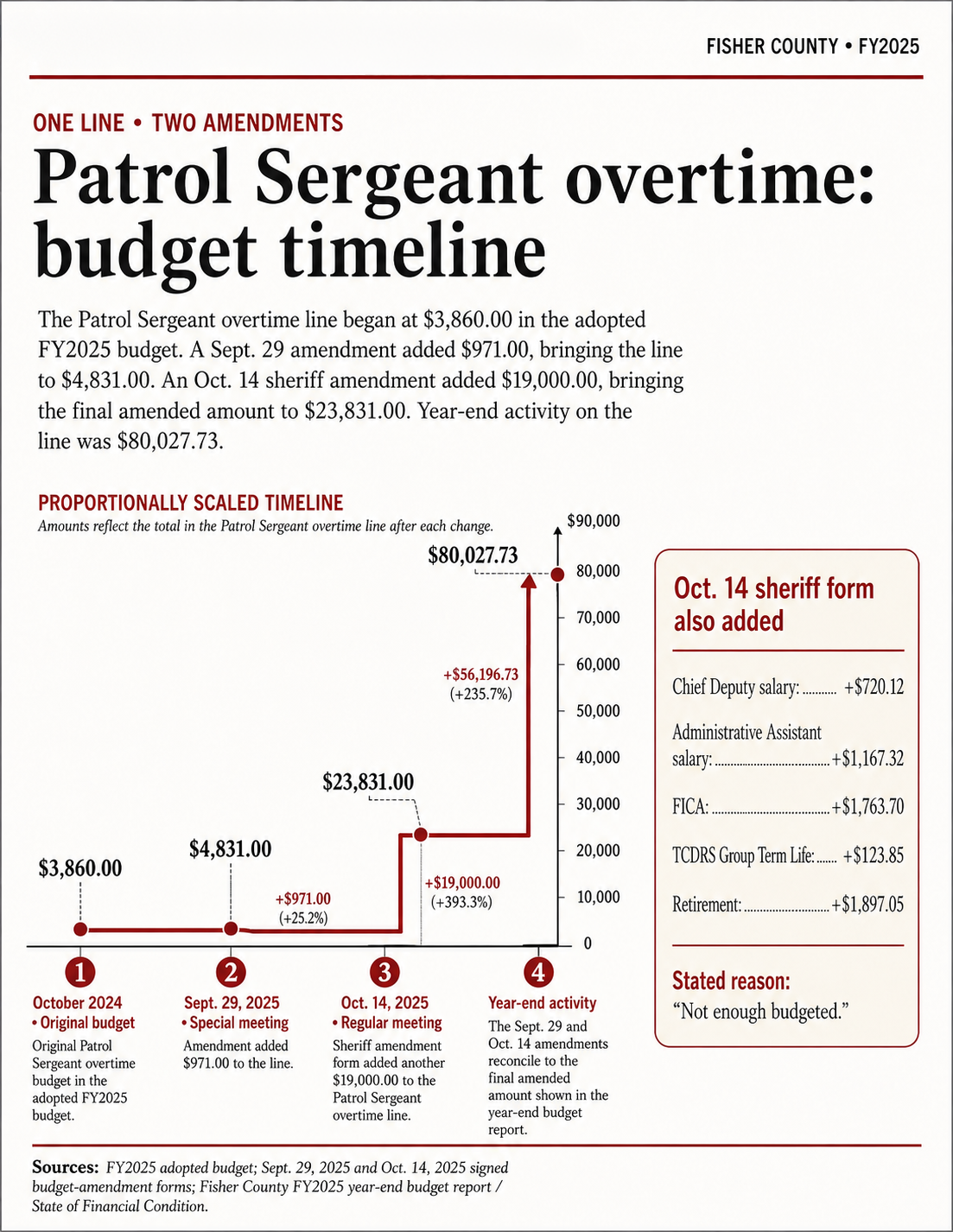
The Patrol Sergeant overtime line increased twice after the original budget was adopted. The line began with an original budget of $3,860. A September 29 amendment added $971, bringing the amended amount to $4,831.
At the October 14, 2025 regular meeting, the Commissioners Court approved what the minutes describe as "several end of year budget amendments (see attached)." The sheriff's office amendment form in that meeting packet lists another $19,000 increase to the Patrol Sergeant overtime line. Together, the September 29 and October 14 amendments brought the final amended amount for Patrol Sergeant overtime to $23,831.
The October 14 sheriff amendment also added $720.12 to Chief Deputy salary, $1,167.32 to Administrative Assistant salary, $1,763.70 to FICA, $123.85 to TCDRS Group Term Life, and $1,897.05 to Retirement. The stated reason on the form reads: "Not enough budgeted."
Those amendments reconcile to the final amended figures shown in the year-end budget report. The records show the paperwork exists. What they raise instead is a question of sequence.
The county's only year-end financial report — its State of Financial Condition, built on a Budget Analysis Usage Report marked "Effective Month 13" — is dated October 7, 2025, a week before the October 14 vote. The DMC could locate no year-end report or State of Financial Condition dated October 14 or later.
Yet the October 7 report already shows the patrol sergeant overtime line carrying an amended budget of $23,831 — the figure that includes the $19,000 the Court did not formally approve until October 14.
There may be routine accounting explanations for that.
"Effective Month 13" refers to the year-end accounting period used to close the books, not to the day a figure was entered, and such reports can be prepared, generated and later reprinted. County Auditor Becky Mauldin, in an interview discussed later in this article, described adjusting line items at year-end as a normal practice to keep departments from finishing short.
WHAT COUNTY OFFICIALS SAID
County Judge Ken Holt, who presided over the September 29 special session, initially disputed that the overtime lines had overrun their budgets.
"No way. It didn't. It can't," said Holt. After being informed the DMC had records showing the lines had exceeded their budgeted amounts, Holt explained the money came from positions that remained vacant. "The overtime, yes, but you've got deputies that we didn't have, so that money goes into it."
Fisher County Auditor Becky Mauldin drew a distinction between the sheriff's office exceeding individual line items and exceeding its overall budget. "They weren't over in their total budget, they were just over in those line items," said Mauldin. "All I took was what we were short in the budget to make us not short in that department, and that's a normal practice that we do up here."
Holt added that the Court does not authorize overtime and that officials are responsible for staying within their budgets. "That's the sheriff's budget to do with what he wants. All we get to do is put money in. If the line item goes out, we have no control over his overtime or anything else he does," said Holt. "I know if you have more payroll, you're going to have more FICA. That's just part of it."
When asked why the Court authorized additional FICA without separately authorizing the overtime that generated it, Holt said: "Evidently it was an oversight. That's the statement."
Holt's statement that the department was not over budget is accurate only when measured against the final amended budget. It does not hold against the budget the Commissioners Court originally adopted. County records show the sheriff's office spent about $132,935 more than its original department budget, and the department finished under budget only after year-end amendments increased that budget by about $133,340.
The amendments themselves are the record that the originally adopted line-item authority was not enough.
When asked why the overtime lines themselves were not fully amended during the year, Mauldin replied: "I don't guess they did because they weren't short in their total budget."
THE BUDGET-CONTROL FRAMEWORK
County officials contend they do not control the sheriff's overtime decisions regarding manpower shortages. However, the county's own finance records show the result was also a budget-control problem, not only a scheduling problem.
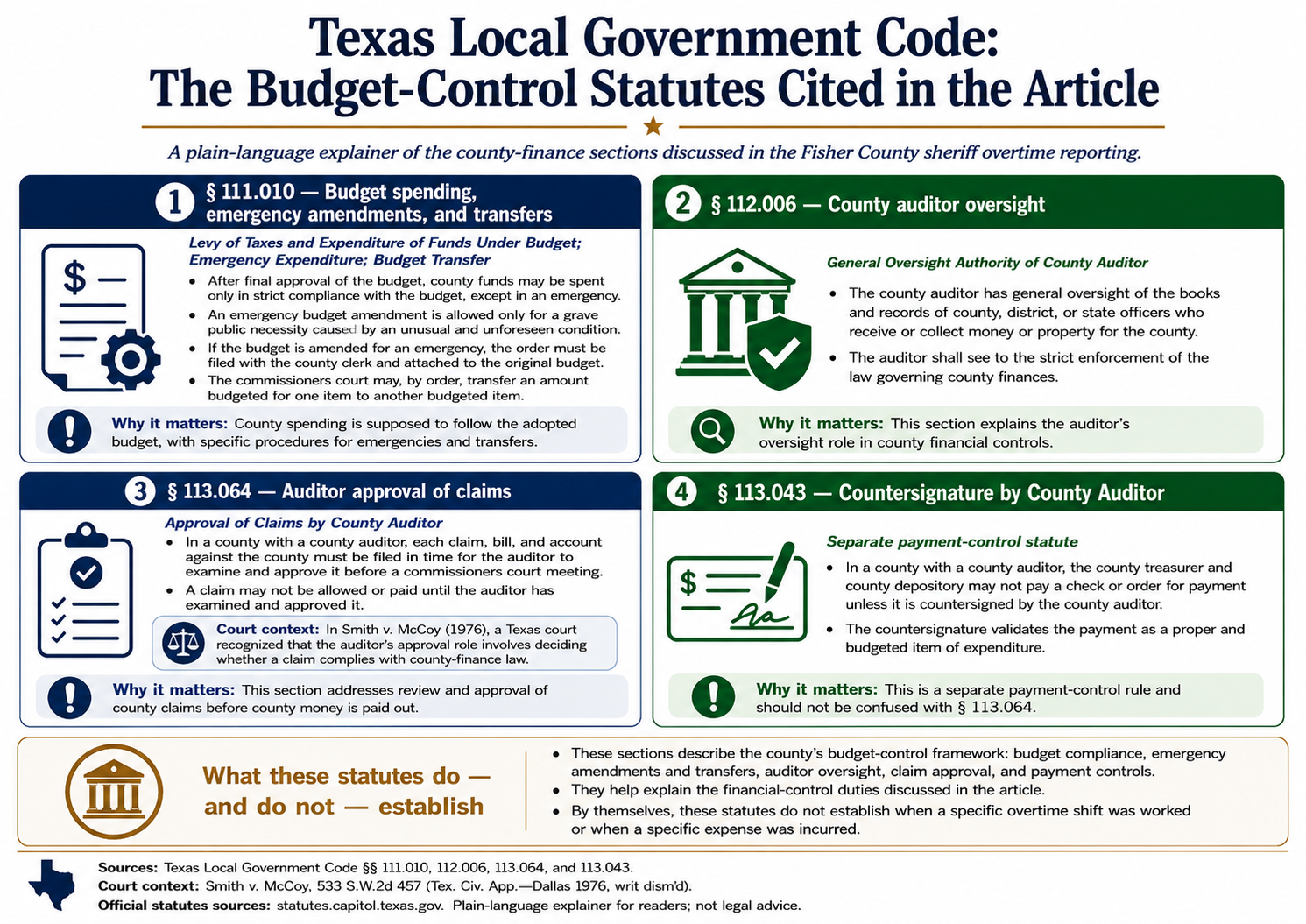
In Fisher County, the county judge serves as budget officer, assisted by the county auditor. Section 111.010 of the Local Government Code requires county funds to be spent in strict compliance with the adopted budget, subject to the statute's amendment and transfer procedures, and allows the commissioners court to transfer amounts between budgeted items by order. A 1997 Texas Attorney General letter opinion reached the same point, concluding that a county budget cannot be amended without complying with that statute.
Separately, Section 112.006 directs the auditor to "see to the strict enforcement of the law governing county finances," and Section 113.064 bars payment of a county claim until the auditor has examined and approved it. Texas courts, in Smith v. McCoy, described that approval as a discretionary duty to determine whether a claim complies with county-finance law.
While those authorities do not allow the judge or auditor to run the sheriff's daily schedule, they do create financial-control duties and budget procedures that can bring overtime overruns before commissioners court for explanation and specific budget action — rather than a single reconciliation after the year has closed.
 HOW THE NUMBERS BALANCED
The department's year-end totals show how those increases balanced out. According to a report generated on Oct. 7th year-end ledger, the sheriff's department closed FY2025 with actual spending of $794,609 against an amended budget of $795,014, leaving $405 under the amended total.
But that "under-budget" finish depended on amendments entered at year-end. The department spent $132,935 more than its original $661,674 budget, and the amended budget itself was increased by $133,340 to absorb it.
That distinction matters, but it does not answer the timing question. The department finished under its amended budget only after the amended budget was increased by $133,340 at year-end.
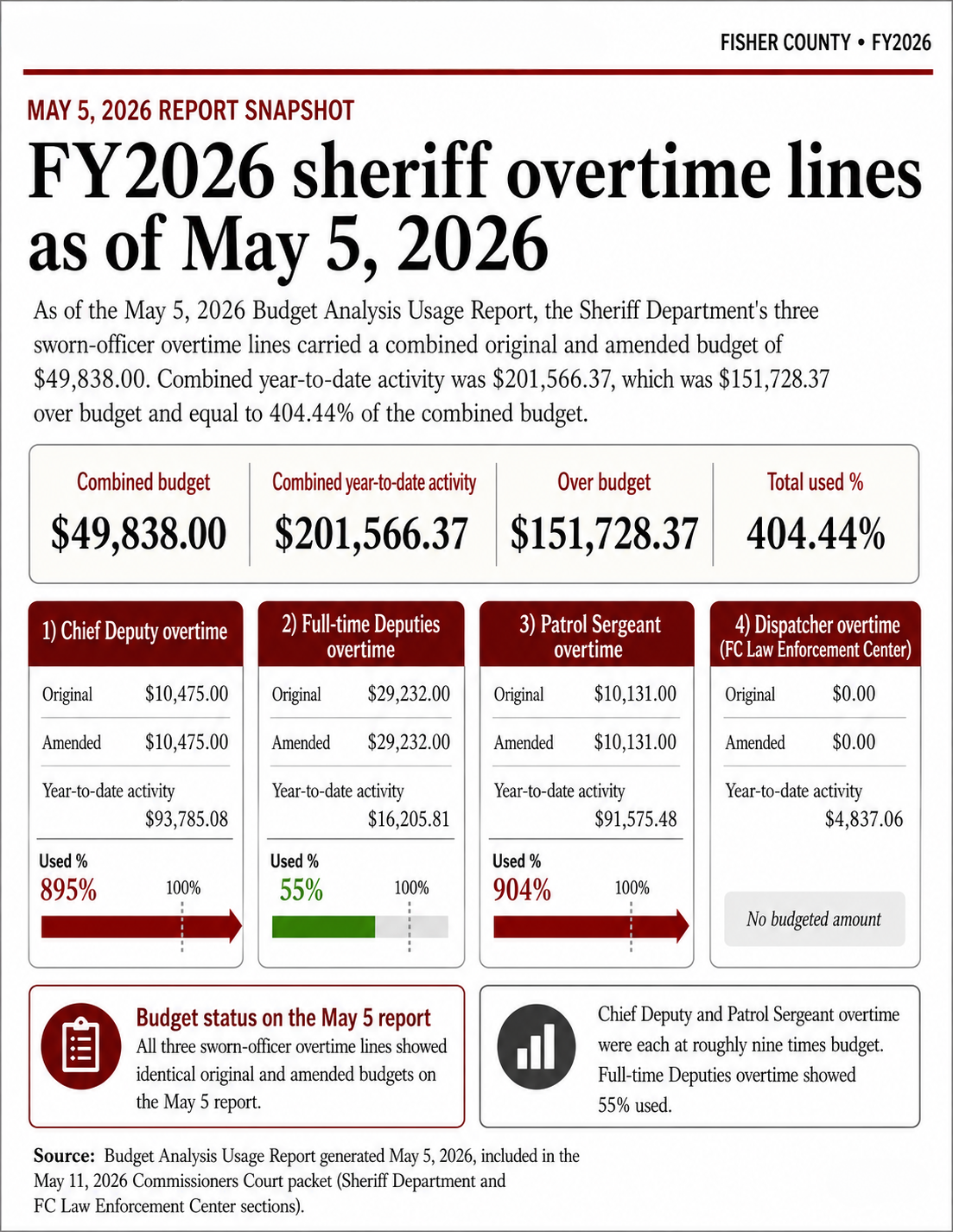
The pattern did not end when FY2025 closed. According to a Budget Analysis Usage Report generated May 5, 2026 and included in the May 11, 2026 Commissioners Court packet, the Sheriff Department's three sworn officer overtime lines carried a combined FY2026 budget of $49,838.
As of that report, roughly seven months into the fiscal year, those three lines showed $201,566.37 in year-to-date activity. That placed the lines $151,728.37 over their combined full-year budget, or about 404 percent of the amount budgeted for the full year.
Most of that activity was recorded on two lines. The Chief Deputy overtime line showed about $93,785 in year-to-date activity against a $10,475 budget. The Patrol Sergeant overtime line showed about $91,575 against a $10,131 budget. Each line was at roughly nine times its full-year overtime budget, with months still left in the fiscal year.
A separate Law Enforcement Center dispatcher overtime line, budgeted at zero, showed another $4,837 in year-to-date activity. Because that line is separate from the sworn officer overtime lines, it is not included in the 404 percent calculation above.
Unlike the FY2025 closeout, the May 2026 report shows no amended-budget change posted to the sheriff overtime lines. On that report, the Chief Deputy overtime line still showed $10,475 as both the original and amended budget, and the Patrol Sergeant overtime line still showed $10,131 as both the original and amended budget. In other words, the report showed no posted amendment to those two lines at that point, even though year-to-date activity on each line was about nine times the amount budgeted.
This first article establishes the scale and the paper trail: the county's payroll system paid what it was instructed to pay; sworn overtime closed the year at more than six times its adopted budget; the county made no significant budget correction as the overruns accumulated, addressing them instead through year-end amendments after the money was spent; and the only year-end financial report on record reflects those amended figures a week before the Court approved them.
In a system funded by taxpayers, questioning those discrepancies is not a bookkeeping curiosity. It is the foundation of public accountability.
The next article turns from the budget records to the timesheets themselves: the individual hour claims that produced these totals and the county offices responsible for reviewing them.
**Update, June 1, 2026: This article has been revised to remove duplicate wording and clarify information from the version originally published in the May 29, 2026 edition.
Sources for this article: Fisher County Year-End State of Financial Condition report (Effective Month 13, Budget Analysis Usage Report dated Oct. 7, 2025); the May 11, 2026 Commissioners Court packet, including the State of Financial Condition and Budget Analysis Usage Report generated May 5, 2026 (Effective Month 5); the Sept. 29, 2025 signed budget-amendment form; the Oct. 14, 2025 regular-meeting packet, including the signed County Sheriff end-of-year budget-amendment form, and the posted meeting video; the DMC's May 26, 2026 Public Information Act request to the County Clerk and County Auditor; 18 Fisher County Commissioners Court minute packets (Oct. 15, 2024–Feb. 9, 2026); FY2025 adopted budget; Fisher County Employee Handbook (sections B-8 and B-9); Texas Local Government Code §§ 111.010, 112.006 and 113.064; Texas Attorney General Letter Opinion 97-051 (1997); Smith v. McCoy (Tex. Civ. App. 1976); the 2024 Fisher County audited financial statements (county land area); the petition for writ of mandamus and the plaintiff's combined response and motion to strike in Hurt v. Dickson (32nd Judicial District Court); and on-the-record interviews with County Judge Ken Holt and County Auditor Becky Mauldin.