
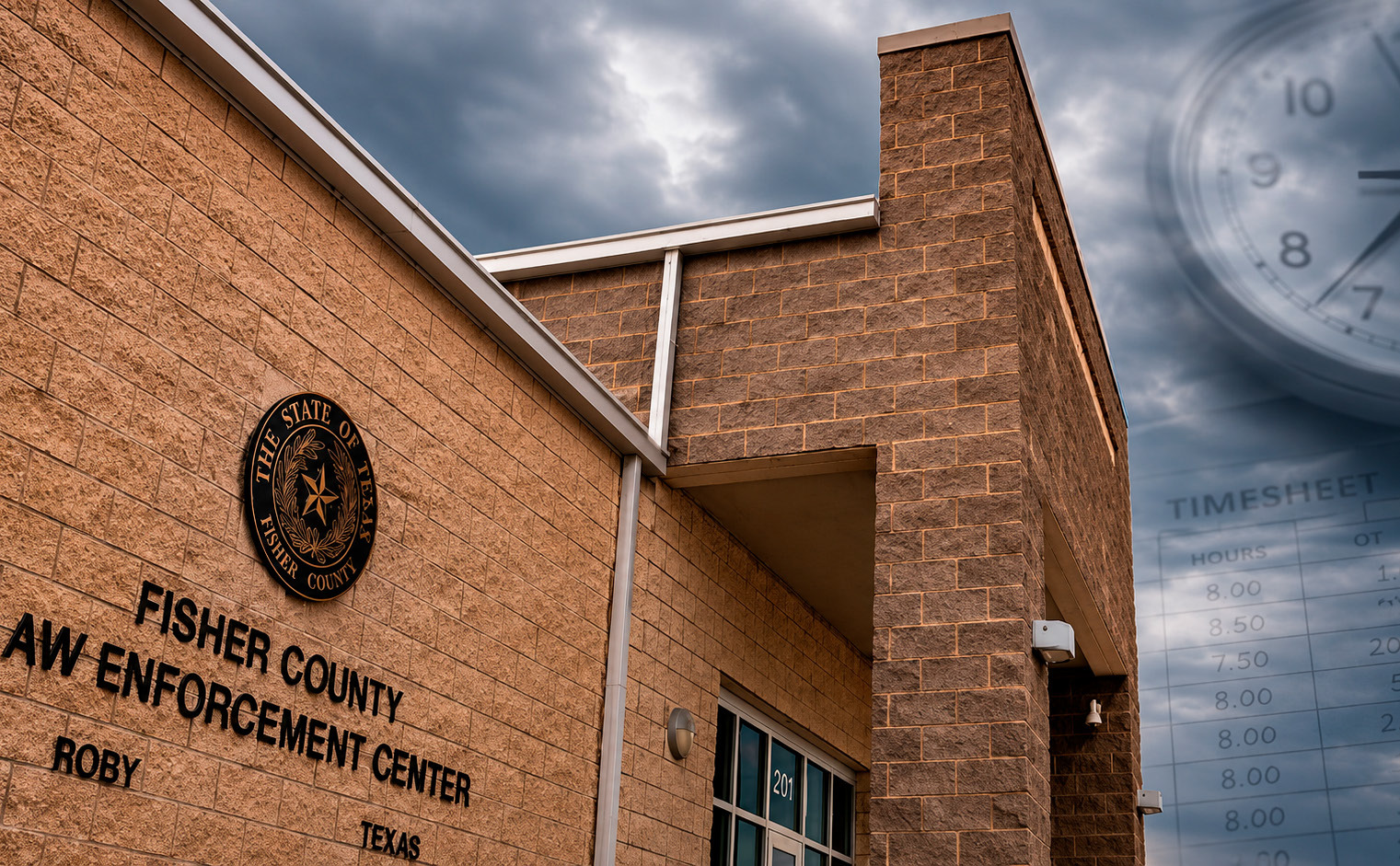
DMC INVESTIGATIVE REPORT - DMC’s review found heavily overlapping deputy shifts, overnight periods with no timesheet-recorded patrol duty and a three-day trip to retrieve an inmate from Mississippi.
Part 3 of DMC’s investigation examines what patrol activity county taxpayers received during periods of extraordinary overtime spending and reconstructs a December 2025 inmate transport to Mississippi and explores the questions it raised.
The first article in this series examined overtime spending within the Fisher County Sheriff’s Office. The second examined the payroll records and timesheets behind those payments.
The next question is what taxpayers received in exchange for those expenditures.
A review of the same records shows that even while deputies recorded some of the department’s longest shifts, there were recurring periods when no timesheet-recorded deputy duty time. The records also reveal that in December 2025, the two deputies who received most of the department’s overtime left the county with only a single deputy to patrol while on a three-day trip to retrieve a Fisher County inmate from Mississippi.
Sheriff John Patrick Dickson defended the scheduling and travel decisions, saying the county remained protected through on-call coverage and that the transport schedule was designed to ensure deputies were rested before taking custody of the inmate.
PATROL VS. COVERAGE
One of the central disputes in DMC’s review involves the distinction between patrol activity and coverage.
The timesheets the DMC reviewed reflect when deputies recorded compensated duty time. Those records can show when deputies reported being on duty, but they do not independently establish every method by which law enforcement coverage may have been provided.
When asked about periods in which deputies were not actively patrolling, Dickson drew a distinction between patrol activity and emergency availability.
“There’s a difference between active patrol and being unprotected,” said Dickson. “It’s been protected 24/7.”
This article examines the patrol activity reflected in the records. The DMC does not claim that no emergency response capability existed during periods when deputies were not actively patrolling. Nor does it claim that no officer was available by telephone, radio, or on-call status.
Instead, the question is what patrol activity county taxpayers received during a period when overtime spending became one of the most discussed issues in county government.
THE HOURS AND THE PATROL PATTERN The timesheets the DMC reviewed show Reyes and Castilleja frequently working some of the longest shifts in the department. Those records show Reyes routinely claiming 18- to 21-hour days and Castilleja routinely claiming 18- to 19-hour days.
The records also show that their schedules frequently overlapped. Rather than being spread across opposite ends of the day, the two deputies often began work within one or two hours of each other and frequently ended their shifts around the same time.
DMC’s review identified multiple examples in which deputies worked lengthy and heavily overlapping schedules while overnight patrol activity remained unrecorded on the timesheets.
On Oct. 29, 2025, all three deputies recorded duty time.
Sgt. Castilleja claimed hours from 5 a.m. until midnight. Chief Deputy Reyes began one hour later, recording hours from 6 a.m. until 10 p.m. Deputy Shane Keisling recorded hours from 9 a.m. until 9 p.m.
Despite all three deputies working that day, the schedules largely overlapped during daytime and evening hours. The records reflect no deputy recording patrol duty time between midnight and 5 a.m.
A similar pattern appears on Nov. 3, 2025. Reyes recorded hours from 6 a.m. until midnight, while Castilleja began one hour later at 7 a.m. and also worked until midnight. Keisling recorded no hours that day. The records reflect no deputy recording patrol duty time between midnight and 6 a.m.
On Nov. 9, 2025, Reyes recorded hours from midnight until 2 a.m., then returned for a second shift from 6 a.m. until 11 p.m. Castilleja began one hour later at 7 a.m. and worked until midnight. Keisling recorded hours from 3:45 p.m. until 8 p.m.
Although all three deputies recorded duty time that day, the records reflect no deputy recording patrol duty time between 2 a.m. and 6 a.m.
Those examples do not establish whether deputies were available by phone, radio or on-call status during those hours. They do show that even on days when deputies claimed lengthy shifts and substantial overlapping hours, the timesheets reviewed by DMC continued to reflect overnight periods in which no deputy recorded active patrol duty time.
Dickson said staffing shortages and officer safety considerations influenced scheduling decisions. The sheriff also said deputies frequently needed to remain available for arrests, transports and other law-enforcement duties that do not fit neatly into a traditional work schedule.
“This is not an 8-to-5 job,” said Dickson. “This is 24 hours a day.”
Dickson also confirmed that he was not responsible for creating officer duty rotations, and that scheduling responsibilities had been delegated to Chief Deputy Amanda Reyes. The DMC reached out to Reyes, who initially agreed to an interview about the department’s scheduling philosophy, including why schedules frequently overlapped rather than being staggered further into overnight hours.
However, just ahead of the interview timing window, Dickson sent an email, where he stated: “I am the Sheriff and Department Head of my agency. I have answered your questions previously, and I am the sole contact for my agency. If you have questions that I can answer, please feel free to contact me.”
The DMC sent a follow-up email to explain the reasoning behind the inquiries regarding the scheduling and the events reported later in this article, saying: “Again, for clarification purposes, and to allow for officers to provide answers to these questions and others, we feel it is paramount that we speak directly with those who were there.”
Dickson confirmed in a later response that, “As far as schedules, I do not provide a written schedule. It seems moot when there are only two law enforcement personnel for the entire county, a fact you seem to have missed in your reporting.
As there are pending issues out there, I will not be responding on certain lines of questioning until these issues are resolved.”
Dickson went on to say, “I will clarify previous remarks gladly, but no new information will be provided as you seem to have the agenda already set for your report.”
THE MISSISSIPPI TRANSPORT
Those scheduling questions became more relevant during a December 2025 inmate transport that removed the department’s two primary overtime earners from Fisher County for approximately three days.
Through a series of Texas Public Information Act request, the DMC discovered an inmate identified as Michael Lee Arnold, who was being held at the Stone County Correctional Facility in Wiggins, Mississippi and had a number of outstanding Fisher County warrants.
Booking records the DMC obtained list those Fisher County charges:
• Possession of Marijuana Less Than 2 Ounces (Class B Misdemeanor)
• Bail Jumping and Failure to Appear (Third-Degree Felony)
• Possession of Controlled Substance, Penalty Group 1, 200 Grams or More (Second-Degree Felony) The Mississippi records show Arnold was released to Fisher County authorities on Dec. 15, 2025, at 8:24 a.m. Additional Texas records show Arnold was booked into the Jones County Jail at 8:51 p.m. that same evening.
Every high-ranking municipal officer and county sheriff the DMC spoke with agreed that given the nature of the charges, an inmate transport was not only justified but was a decision they would have also made. However, those same officers also said the timeline Fisher County Deputies reported during the transport raised equal questions.
RECONSTRUCTING THE TIMELINE The Fisher County Sheriff’s Department continues to withhold the Automatic Vehicle Locating AVL/GPS records — which should include the December 2025 timeframe — against 32nd Judicial Judge Glen Harrison’s order to release them, according the motion DMC Editor Jeff Hurt filed with the court earlier this month. A hearing to hear that motion has been set for next month on July 8.
However, travel-related transactions along with TX and MS jail records the DMC reviewed allow a partial reconstruction of the trip.
On Dec. 13, records show purchases in Abilene and Lindale, Texas. A fuel transaction at QT in Lindale was recorded at 5:58 p.m.
Hotel charges place the deputies in Bossier City, Louisiana, later that evening. According to credit card receipts, transactions for accommodations at the Courtyard Bossier included two separate charges for hotel rooms — $127.60 each — totaling $255.20.
Timesheets reviewed show Reyes claimed 21 hours on Dec. 13 while Castilleja claimed 19 hours during that timeframe.
On Dec. 14, Reyes resumed duty at 6 a.m. and Castilleja resumed duty at 7 a.m., according to those timesheets. Despite the early morning start time, deputies remained in Bossier City.
This fact is confirmed by a credit card transaction at BeauxJax Crafthouse in Bossier City, which occurred at approximately 12:33 p.m. that day.
Neither the timesheet justification sections, Sheriff Dickson, nor the deputies have provided any clarity or answers to this unaccounted- for gap in timesheets in the travel records. Sometime after lunch, deputies continued toward their destination, a roughly 5 hr 45 min drive.
Additional travel-related transactions place the deputies in Mississippi later that same evening. Records show two hotel chages — $119.90 each — at a Hampton Inn in Wiggins, Mississippi, totaling $239.80.
Timesheets for Dec. 14 show Reyes and Castilleja each claimed 18 hours of compensated work during that time.
On Dec. 15, Michael Arnold was released at 8:24 a.m. in Mississippi and booked into the Jones County Jail at 8:51 p.m. in Texas. Reyes and Castilleja also claimed 18 hours of compensation during that final day of transport.
THE EXPLANATION
Dickson told DMC the travel schedule was designed to ensure deputies were well-rested before taking custody of the inmate.
“You always take your time getting there because you don’t want to have any kind of accident or anything on the way,” said Dickson during a telephone interview on May 14, adding how deputies alternated driving duties on the return trip and were able to return to Texas in a single day because they had rested before taking custody of the inmate.
Nevertheless, Reyes logged 39 hours and Castilleja logged 37 hours of compensated time, leaving between 9 and 11 total hours of possible rest during the 48 hour period before retrieving their prisoner.
Additionally, based on the fuel and hotel receipts, the DMC estimates the travel team arrived at the first hotel location at around 8 p.m. When asked what county business the deputies were conducting between the arrival time and when they stopped charging time at midnight, the sheriff said it was a combination of reports and supervisory duties.
“They have their laptops that they're working on reports, and the chief deputy also had to play dispatch supervisor during that time,” said Dickson. “So any questions dispatch had came to her.”
However, the records are not that clear. While Reyes and Castilleja were traveling through Louisiana and Mississippi, Deputy Shane Keisling remained in Fisher County. Dickson told DMC that the county remained protected during the transport and said Keisling was available and on call despite the low call volume.
“You do get a night with no calls, you know,” said Dickson. “Just so happened that was on a weekend, and it was a weekend where there wasn't a lot of activity. Okay, well, there were no calls for him to go to.”
Keisling’s time sheet for that same transport window does not show continuous recorded duty time. On Dec. 13, he recorded three separate time entries: 7 a.m. to 8 a.m., 4:30 p.m. to 9 p.m., and 10:30 p.m. to midnight, for a total of 7 hours. On Dec. 14, he recorded time from midnight to 12:30 a.m. and from 3:45 a.m. to 5:15 a.m., for a total of 2 hours. On Dec. 15, he recorded a 12hour shift from noon to midnight.
This response raised questions about what, if there “wasn’t a lot of activity” and “no calls for [Keisling] to go to,” what oversight Reyes was providing for dispatch that required remaining on duty until midnight. In an effort to obtain answers to these and other questions within the timeframe, the DMC sought additional records.
On May 29, 2026, DMC submitted a Texas Public Information Act request seeking CAD records, dispatch records, call-for-service records and unit-status records covering portions of 2025 and early 2026 — which included the Dec. 13 - 15 inmate transport timing window. Those records could provide additional context regarding patrol activity, dispatch workload, unit availability and operational activity during periods examined in this series.
Per the TPIA, a governmental agency has 10 business days to notify the requestor that the agency is seeking an attorney general opinion for withholding the records or that the request is requiring an unusual amount of time to complete and inform the requestor of a future date the request will be fulfilled.
On June 12 — day 10 in the process — Dickson sent a response, stating that “Due to the late guidance” from County Attorney Morgan Brooks, the records were still being compiled and would be available as soon as possible. Dickson added, “I do not anticipate a long delay.”
Those records were not provided ahead of the DMC’s publication deadline for this week’s edition, and the contents of those records were not able to be included in this report. Whether additional records and future interviews resolve the remaining questions could determine the direction of follow-up portions of this ongoing report.
However, other records the DMC reviewed during its investigation have raised additional questions regarding other forms of compensation, transparency issues, and ethics, as well as the future leadership of Fisher County law enforcement. Those issues will be examined in future installments of this series.