
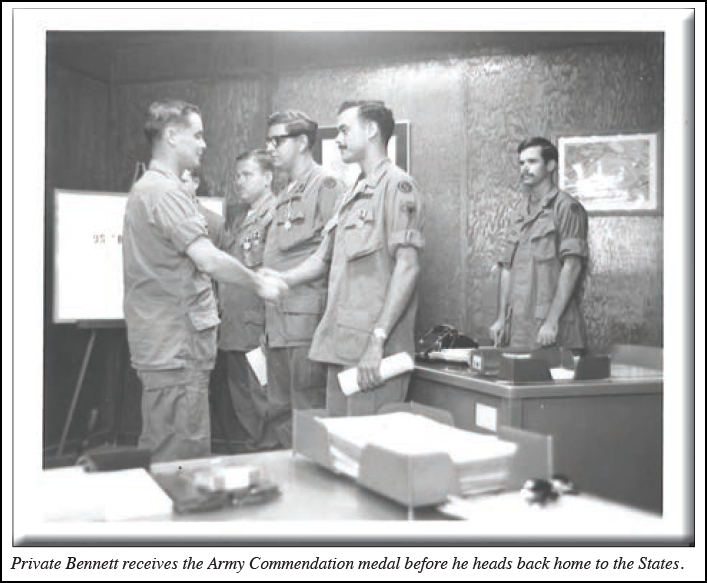
Before serving more than 30 years as Fisher County judge, Marshall Bennett spent more than a year in Vietnam helping identify and prepare fallen service members for their return home.
From the DMC Archives: This article was originally published in the Double Mountain Chronicle Veterans Edition on Nov. 16, 2018. Volume 112, Number 11.
Reader note: This article contains graphic descriptions of wartime death, human remains and military mortuary work.
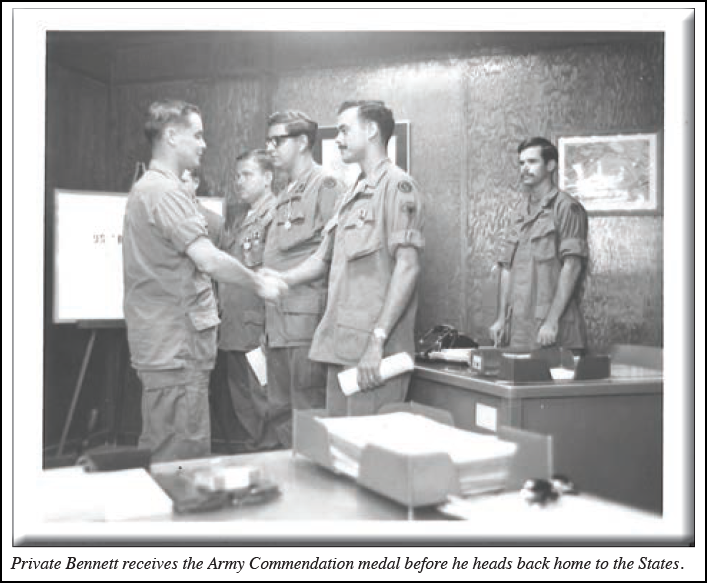
The term "hero" is most often used in its literal definition, equated with those like valiant, fearless, and noble, our subconscious flashing images of warriors or champions. We rank our American soldiers among such heroes, caretakers of liberty. Protectors. Servicemen and servicewomen, who work, fight, and too often die so that we may live our lives with the luxury of freedom.
It seems leaders from every generation have coined some variation of the phrase: Old men get you into war, and young men die.
The soldiers Bennett remembered
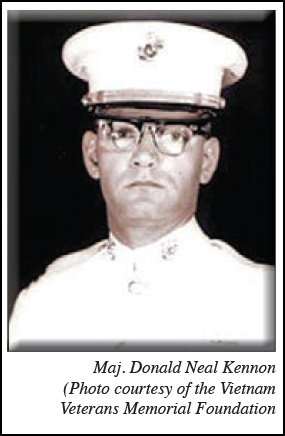 Men like U.S. Marine Corps Major Donald Neal Kennon from Sweetwater, assigned as the Battalion Operation's Officer to the 1st Battalion, 9th Marine Regiment, 3rd Marine Division in December 1968.
In February of 1969, Operation Dewey Canyon I took place 35 miles from the border of Laos, at the northern end of the A Shau Valley in the Quang Tri Province. Kennon was setting up the battalion command post when a sniper's bullet found its mark.
Soldiers fight, and soldiers fall. And we commemorate and memorialize them. And we owe this opportunity to another kind of hero. One whose single duty was to protect the memory of those who die on the countless battlefields that litter the road to freedom and fill the pages of history. Soldiers; unsung heroes like Private First Class Marshall Bennett.
It was Bennett who wrote to the funeral home in Sweetwater, explaining it was he who was with Kennon at the end. Bennett said he "walked him through" with the honor, dignity, and reverence deserved.
Bennett worked on a lot of men, a lot of soldiers, but the name that remains on the surface of his memory is that of First Lieutenant Sharon Ann Lane, one of eight American military nurses who died while serving in Vietnam.
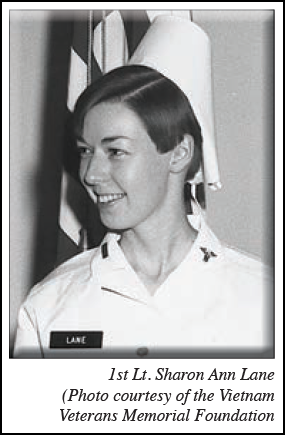
Born July 7, 1943 in Zanesville, Ohio, Lane graduated from high school and pursued her dream of becoming a nurse at the Aultman Hospital School of Nursing. She graduated in April 1965. Lane completed three quarters at the Canton Business College before joining the U.S. Army Nurse Corps Reserve in April 1968.
One year later, she reported to Travis Air Force Base, California, with orders sending her to Vietnam. She arrived at the 312th Evacuation Hospital at Chu Lai that same month.
Originally assigned to the Intensive Care Unit, Lane was reassigned to the Vietnamese Ward 4.
Despite the physically and emotionally challenging duties, Lane repeatedly declined transfers to another ward.
She worked twelve-hour days—five days a week—and usually spent off-duty time in the Surgical ICU, caring for the most critically injured American soldiers.
The hospital was struck by a salvo of 122mm rockets fired by the Viet Cong on the morning of June 8, 1969. A rocket struck between Wards 4A and 4B. First Lieutenant Lane died instantly of fragmentation wounds to the chest.
The only American nurse killed as a direct result of hostile fire, Lane was one month shy of her twenty-sixth birthday.
We remember this because soldiers like Private 1st Class Marshall Bennett were there, documenting the final moments of a soldier's life, journaling the story of how they died with the care given to a precious work of art.
"It was the only place where you dealt with heroes every day," said Bennett.
From a Rotan funeral home to Vietnam
Drafted in December of 1967, Bennett was in his early twenties when he began basic training in Fort Polk, Louisiana. From there, it was Fort Bragg, North Carolina, then Fort Lee, Virginia. He was one of 18 men from all over the country specially trained as search and recovery specialists and sent to Vietnam.
As a high school student, Bennett took a job at the local funeral home in Rotan, TX. He became interested in the work and went to embalming school in Dallas after graduation. Bennett was already a licensed embalmer and married to his high school sweetheart at the time he received his draft notice.
He was to be attached to an infantry division as part of a grave registration unit. However, Da Nang superiors discovered Bennett was a licensed embalmer. New orders were issued.
When he reached Vietnam, he realized that as a 21-year-old, he was the old man of the group. The average age of his new unit was 22. "The men we were embalming were no more 18 or 19 years old; most of them," said Bennett.
Inside the Marble Mountain mortuary
The Tet Offensive began January 30, 1968. It lasted until September 23 of that same year. Bennett arrived in Vietnam in August. He was assigned to the Marble Mountain Complex just south of Da Nang, Vietnam. The mortuary was significantly backlogged.
Bennett worked practically seven days a week for the next eight straight months until they were back on track, and when Bennett was reassigned to duties in the identification division. The Army employed civilian embalmers who took the 12-hour day shift while the military worked throughout the night.
"The civilians worked during the day, the Army worked at night," said Bennett. "We got all the bad parts."
Bennett reflected on the events in May 1969 and what the Vietnamese called Dong Ap Bia, military planners referred to as Hill 937, and what history remembers as Hamburger Hill. "There were so many screw-ups that just got those boys killed," said Bennett.
Identifying the fallen
Typically, bodies were brought to collection areas until they could be processed at the mortuary. However, during the 10-day siege, bodies were being brought directly from the field by jeeps, trucks, helicopters, even tanks. Many were from the Marine Corps; others were from the Army's 101st Airborne and 1st Cavalry Unit.
Bennett spoke of a soldier who was trapped in a tank where the fire inside burned at temperatures thousands of degrees. What remained was little more than blackened and charred skin stretched over the framework of his skeletal structure.
He remarked on the skills of the young soldier who found a way to extract fingerprints in this most unlikely of scenarios. The young man went to work, delicately removing the charred layers of skin from the soldier's thumb. After painstakingly removing the number of layers he was able to use tissue builder to locate the ridges and reconstruct the thumbprint to make a positive identification.
"There is nothing positive about war, except, without them, you save a lot of people's lives," said Bennett. "War is nasty."
Identification was usually done through fingerprints, although, sometimes dental records are necessary. Bodies were often in poor condition, missing limbs, with burned and charred flesh, or severely decomposed.
The Army shipped them home every day, returned to the United States based on soldiers' residence. Anyone from north of the Mason-Dixon line was sent to Dover, Delaware, south of the line was sent to Oakland, California. The only other shipment made with such regularity was mail deliveries.
Bennett said he had heard the aluminum cases used to send the bodies back to the United States were returned to Vietnam full of mail but never verified this rumor, as he never saw the boxes come back. He saw many of them leave.
The nighttime unit would process the paperwork from the day shift as well as their own, at that time, an average of 15,000 bodies per year. Often his unit was totaling approximately 200 bodies per day.
“It was an honor”
"We always considered it such an honor because our service was to get the boys back to their families. That's the way we all looked at it," said Bennett. He recalled spending the time to care for one soldier so his twin brother could come in and identify his body.
"It was an honor, a real honor. Each was respected, and we treated them with dignity and reverence."
Why they called them “body-baggers”
Although his unit performed other military functions, pulling guard duties like other personnel, for the mortuary unit, it was largely a life of solitude. With an unspoken superstition that those who care for the dead are bad luck, other soldiers had little interaction with men from Bennett's unit.
"The other soldiers didn't want to have much to do with us," said Bennett. "They called us 'body-baggers.'"
Soldiers caught falling asleep on guard duty would often be sent to the mortuary to perform duties as a punishment. "They were sending guys down to where we worked as punishment," said Bennett. "That must be pretty bad."
Despite the fact the base airport was one of the busiest in the world, whose mess hall served breakfast 24-hours-a-day, it was frequently vacant in their presence. Bennett remembered how he and a few others from the unit had attended a theater at a surrounding base.
Shortly after being seated, they were asked to leave because of the odor. Bennett and his unit smelled of the battlefield, of the bodies, of death. "We were used to it."
Isolated from contact with almost anyone outside of their unit, working long, consecutive hours immersed in the worst of human atrocities with little downtime, Bennett said most of them found a coping mechanism in alcohol. As a result, a majority of the breaks in the action are filled with stories, which cannot be censored—and as such, must not be repeated here—although, most of Bennett's day was filled with serious matters.
Working under rocket fire
There was no safe place in Vietnam. "There was something all the time," said Bennett. He remembered how his nighttime unit worked under the fallout of rocket fire for over 30 consecutive days.
One such rocket struck a pallet of embalming fluid, which ignited and burned like gasoline. The burning fumes incapacitated the first of the Marine firefighters who came to extinguish the flames. The point of impact was just behind the personal effects building, where the soldiers' personal items were logged, inventoried, and stored until they could be returned to the families.
A piece of shrapnel ripped through the personal effects building and tore a gaping hole in the chair where only 30 minutes prior, Bennett had been finishing paperwork. "It just wasn't my time," said Bennett. After serving more than a year in Vietnam as a mortician, a week after the explosion, Bennett returned home.
Life after Vietnam
He continued to do mortuary work for the next few years, and still maintains his license, recently receiving a 50-year service recognition from the State of Texas. After a brief stint as a grocery store owner, Bennett won the 1978 election for Fisher County Judge. He would continue to serve for more than 30 years.
Married to Chris Bennett before the war, Marshall Bennett laid his wife of 46 years to rest in 2012.
The memories that remained
In reflections upon his life and time of service, Bennett said he feels the anxiety build around days like Veterans Day or Memorial Day. Like in his quiet times and he remembers, and how sometimes, the nightmares still come.
Nevertheless, the cantankerous and eternally patriotic Bennett said he supposed it was a decent tour, a positive experience, full of good memories and bad ones alike. "It was horrible, but it was an honorable job. And I take a lot of good memories with it."
Photo credits in the original print edition: Maj. Donald Neal Kennon and 1st Lt. Sharon Ann Lane photos courtesy of the Vietnam Veterans Memorial Foundation.