
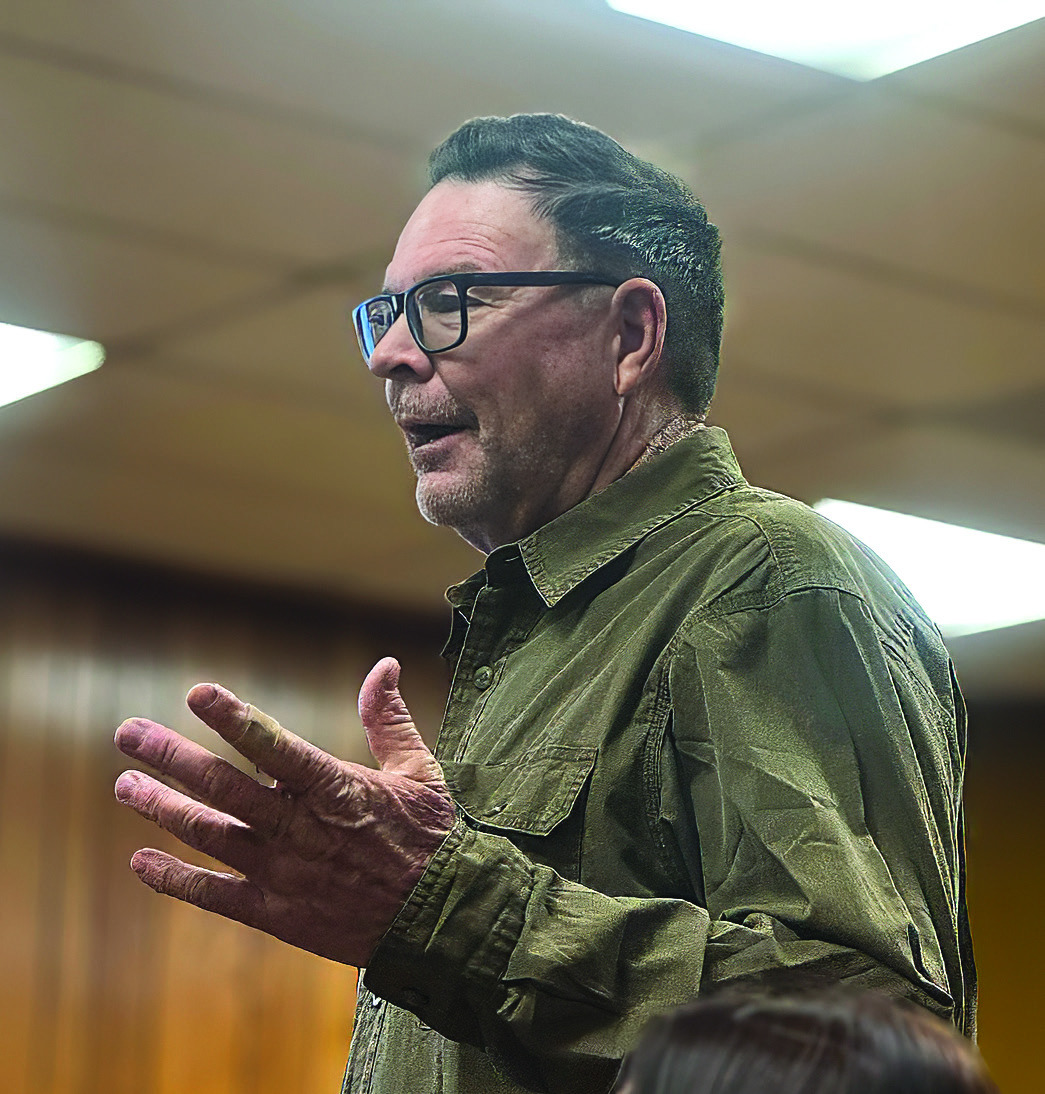
Resident living near proposed data center asks commissioners to consider land use, traffic and long-term effects on rural quality of life.
A Fisher County resident provided public comment during the February Commissioners Court meeting, voicing concerns about the expansion of renewable energy projects and a proposed data center near FM 540, citing impacts to land, traffic and quality of life.
Kit Page, who said he lives approximately two and a half miles from a proposed data center site, told commissioners he believes large-scale projects are reshaping rural land in ways that deserve closer scrutiny.
“I don’t believe this was fully thought through,” said Page. “Quality of life is all I’m interested in. I’m not interested in big money. I want to check my ranch land, check my cattle, raise my grandkids out here.”
Page referenced ongoing wind, solar and data center development across Fisher and neighboring counties, including IREN’s proposed data center project. He said he only recently became fully aware of the scale of the project after seeing signage posted.
“They’re talking about buying thousands of acres for solar and a data center — just tearing the heart out of ranch and farm land,” he said.
Questions About County Authority
Page questioned whether the county had authority to regulate such projects through land-use approvals or building permits, with officials explaining the government’s limited powers.
“So, there’s no county land-use approval?” he asked, hearing from officials how they have little control over what landowners agree to. “I thought if you build something, you’d have to have county approval — permits — to put up a huge building in your county.”
Texas counties generally do not have zoning authority over private land use in unincorporated areas, limiting their regulatory reach unless specific statutory authority applies. Some taxing entities, however, can extend or deny tax abatements, which the county, as well as hospital and school districts, have done in the past.
Page also expressed concerns about increased traffic, potential strain on roads and changes to the rural character of the county.
“What are we gaining by selling out to data centers, AI centers, solar farms, and wind farms?” he asked.
Tax Agreements and County Finances
Fisher County has approved multiple renewable energy tax abatement agreements in recent years, including wind projects such as Mesquite Star and BayWa, as well as Engie’s solar farm and IREN’s data center in late 2024. Agreements such as these typically include payment-in-lieu-of-tax (PILOT) structures and value limitation arrangements negotiated with outside legal counsel.
In prior DMC coverage, county officials have said such projects contribute to local tax revenues, school bond capacity and reserve growth. The county has received around $800,000 annually for several years, now over halfway through the 10-year terms of those agreements. Two additional abatement agreements — with IREN and Engie — are set to begin when those projects come online, possibly by the end of the year.
During the February meeting, Treasurer Jeanna Parks reported that after reconciliation, the county’s total fund balance stood at approximately $9 million. She said the county earned nearly $30,000 in interest for the reporting period and that roughly 79.4% of county funds are currently invested in a higher-yield money market account earning 3.69%.
The county has reported strong reserve growth across consecutive fiscal years, including a previously reported nearly $2 million increase in net position during the most recent audit presentation.
“Give It Some Thought”
Page acknowledged that some projects may already be too far along to reverse but urged commissioners to weigh long-term impacts when considering future developments.
“I trusted — maybe ignorantly — that the people I elected would protect us and keep us safe in Fisher County,” he said.
He concluded by asking commissioners to consider the moral and generational implications of large-scale industrial development in rural communities.
“I’m pleading with you: give it some thought, and give it some prayer.”